

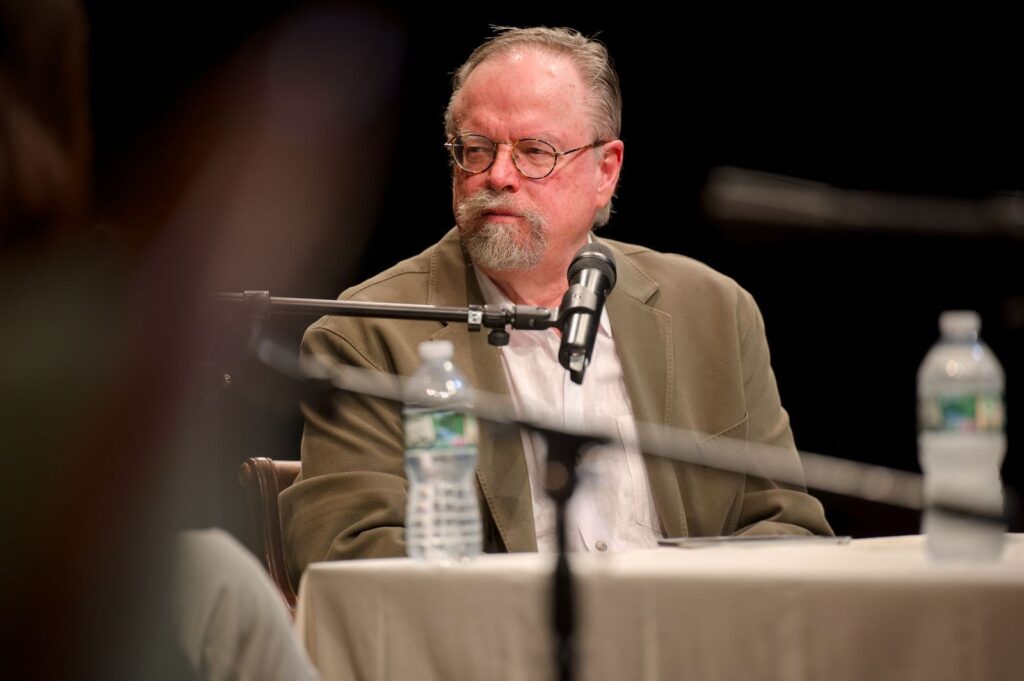

Colin McEnroe: A Half Century of Covering Connecticut with Wit, Curiosity and Heart
By Frank Rizzo
For many, Colin McEnroe is the voice of Connecticut.
The journalist, columnist, humorist and radio host would cringe at that statement, being famously self-deprecating and socially squirmy when receiving anything resembling a compliment. But that’s how many of his friends, admirers and colleagues might describe him—at least for the sake of a grandiose lead graph in a profile that is sure to be short in credits, incidents and details of his professionally rich and peripatetic life.
For nearly 50 years, McEnroe has been engaging with newspaper, magazine and online readers as well as commercial and public radio listeners throughout the state with the sincerity of a trusted friend (albeit sometimes cranky, but brilliant). McEnroe’s quick wit, chattering charm, and encyclopedic knowledge of the profound and the trivial also makes him Connecticut’s go-to guy to emcee events, host gatherings or lead on-stage conversations. Over the years, those interviews on air, on stage and in print include such varied figures as Stephen King, Anthony Bourdain, Barack Obama, Joyce Carol Oates, Salman Rushdie, Kurt Vonnegut, Bob Woodward, Hal Holbrook, Alice Waters and Anita Hill, to name just a few of the thousand or two he’s done over the decades.
Besides covering celebrities, state and national politics, current events, and pop culture, his WNPR shows also embrace the easily overlooked minutiae of life: zippers, ringtones, snacks, VHS recorders, handshakes and more.

To some, McEnroe is an empathetic interviewer, a pithy social critic and perceptive commentator. Others love him for his humorous takes on subjects serious and silly. To critics, he’s a curmudgeon, lefty and smarty-pants.
“People may have this perception of him of always having to be the smartest person in the room,” says Robyn Doyon-Aitken, WNPR’s deputy director of audio storytelling and talk shows. “Very often he is the smartest person in the room, although he doesn’t think so. He’ll tell you his broad knowledge of things is ‘only an inch deep.’ But it’s at least a foot.” (Alec Baldwin called McEnroe “the Orson Welles of Public Radio.”)
Sitting in to watch a broadcast of McEnroe’s eponymous weekday 1 p.m. program from WNPR’s Hartford studios, producers Lily Tyson and Jonathan McNicol and technical producer Dylan Reyes are on the other side of the glass. Later in the week, he would be doing a show on the Nobel Peace Prize, but this was Monday; it was the weekly “Ask or Tell Me Anything” program. Listeners called in on a wide range of topics as McEnroe kept conversations lively with his signature asides and digressions. “You’ve given me a lot to think about,” he says to one caller, adding, “though I’m not sure I’m going to enjoy thinking about it.”
A Curious Mind
McEnroe seemed to have been a thinker from the start. He grew up in West Hartford and attended Kingswood-Oxford School. There, he was greatly influenced by a teacher who had a stunning breadth of knowledge on a multitude of subjects. “I thought, ‘That’s what it’s like to be educated,’ so that idea of knowing something about a lot of things started early,” adds McEnroe.
Unsure of his future path, he knew as editor of his high school newspaper he had an ease in writing and figured, “I’m probably going to be spending the rest of my life doing tap-tap-tap on my manual Smith-Corona.”
Writing was perhaps also in his DNA. His father was playwright Robert E. McEnroe, who had several Broadway works produced. The 1948 “The Silver Whistle” play, which was made into the 1951 “Mr. Belvedere Rings the Bell” film starring Clifton Webb, and the short-lived 1961 “Donnybrook” musical. But because of frustrations with his career, his father later turned to real estate. He wrote about his father and their relationship in his frank and touching 2003 memoir, “My Father’s Footsteps.”
“You know how a lot of fathers want you to go in the family business? He was the opposite, telling me [becoming a writer] is not a good thing to do. So, I struggled with that for a while.”
When McEnroe arrived at Yale in the early 1970s, he had no idea what his trajectory would be. “I was an American studies major, which is the major when you don’t know what your major is.” It turned out, he says, to be good preparation for his later careers.
He began working for The Hartford Courant in 1976 as a summer intern. There he admired and was mentored by another polymath, Malcolm Johnson, the longtime arts writer and theater critic. At the newspaper, McEnroe was a reporter, feature writer, critic, serial novelist and, most notably, columnist.
Radio Days
In 1992, a column critical of the conservative direction talk radio was heading led to him being a guest host at two Hartford radio stations: WPOP and WTIC. “At the end of each shift, I was offered a job, which is funny because my whole take was that it was this bad medium full of jerks appealing to the worst instincts of a human being. To learn that I was a natural at it was somewhat disconcerting.”
There were growing pains for the newbie host in this new communications medium. “What helped was that I didn’t sound like anyone else. People perhaps looked past certain things because it seemed original and, with my sort-of-liberal politics, hardly anybody else was talking that way.”
His initial radio persona was an awkward fit. “They paid me to be a smart, reasonably well-informed brat, though they didn’t use that word. They wanted you to be ‘vivid.’ When you work in that kind of talk-radio environment, they keep wanting you to ‘push the envelope’ until one day you push too far, and then they fire you.”
When his show was cancelled and replaced by provocative therapist Dr. Laura, listeners and media figures protested. McEnroe eventually got a new gig at the station co-hosting an afternoon program. That show ran until 2008’s economic collapse when stations were cutting costs, “and those with centrist-left views were just gone.”

WNPR Comes Call-In
For years, McEnroe also had a thriving freelance writing career with book collections of his essays; a stint as a playwright at the Ivoryton Playhouse; university teaching and speaking gigs; and stories for publications such as Cosmopolitan, Metropolitan Home, Bicycling, Men’s Health, Forbes, The New York Times and the Hearst Connecticut Media Group.
He didn’t have to wait long before joining WNPR, the state’s public radio station, which was more simpatico with McEnroe’s personal style and sensibilities.
“I discovered nothing I did on commercial radio would work here,” he states. “It’s different in a million ways. For one, this is a producer’s medium and whoever is producing has a lot to do with the show.”
McEnroe also adapted to a more tempered tone while retaining his quirks and curiosity. Besides serious and semi-serious programs, there were also off-beat topics which he brands under “the Department of Bad Ideas” banner. “The last time we did a show just to see if we could have a show on a strange subject. It was one about towels, which actually turned out to be okay. Another was on toast…or was it toasters?” The one on spoons? Not his finest, he admits.
“But I also remember we did a show about whistling, taking it from so many angles—and it was great. If my name was Ira Glass, I’d be done for the week after that show. But I have to do another show the next day and the day after that.”
At 71, and with the demands of his time both personally and professionally unabated, McEnroe’s has recalibrated his schedule. With Monday for call-ins and Friday’s “The Nose” featuring guests who schmooze on pop culture, he now has just three weekly shows to prepare for his deep dives. “There are times when it takes a toll,” he says of his present life, “but it’s hard to do something else.”
Being Connecticonic
When asked if McEnroe is his generation’s Bob Steele, the legendary Connecticut radio host who was on the air for more than 60 years, Doyon-Aitken, says, “that comes up sometimes. But he’s not the next Bob Steele—or anyone else—because he is so who he is. There’s no one else like him. But I do think Colin is a Connecticut icon.”
As for legacy, McEnroe says he is only focused on what’s in front of him. “I’m not thinking about the 25 or 50-year arc of a career. Though at times I feel like I’m the ‘Oldest Confederate Widow,’” quickly adding, “I’m joking.”
A friend recently remarked to him: “You almost have to wonder whether you would feel that you were Colin McEnroe if you weren’t doing this.”
“When he said that I thought, ‘How sharper than a serpent’s tooth!’” he adds laughing, quoting from “King Lear.” “This is the kind of job that takes over your life, and I like that. I like it more than I would if I was just trying to be Colin McEnroe, the person. So yeah, its fine.”
Frank Rizzo is a freelance journalist who writes for Variety, The New York Times, American Theatre, Connecticut Magazine, and other periodicals and outlets, including ShowRiz.com. He lives in New Haven and New York City. Follow Frank at ShowRiz@Twitter.
Q&A
What was the program that elicited the most response from listeners?
Quite recently, my interview with Timothy Snyder sort of went viral. It probably has more to do with Tim than with me. But you can see that the YouTube of the audio (youtube.com/watch?v=tXdfumSUyII)—which is not how the show is heavily consumed usually—has 75,000 views.
Who was the person you were most intimidated to interview?
[English playwright Tom] Stoppard. Nobody even is a close second. We did the episode live in the lobby of the Studio Hotel. I was so nervous. Then the tablet with the rundown—our vague outline for the show—crashed. When Stoppard walked in, I was at the front desk, where they were trying to help me pull up the rundown; I think it made him think he was being interviewed by a bell boy or something. The interview limped along and then I asked him a question about a connection between “Tumblers” and “The Hard Problem” (a play which had not yet been staged). He was startled and said, “I have not mentioned that to anybody until now.” His whole demeanor changed. He started calling me “mein host,” which seemed to be a positive thing.
What was one of your most emotional moments of the show?
In 2021, my son was very sick. [Partner] Kathleen was very sick. Both hospitalized. I wasn’t sure either one of them would survive. I was experiencing emotions every day that were new and strange to me. So, I decided to do a show on grief, which was both a good and a terrible idea. About ten minutes in, I started crying. And the person on the air with me was Nelba Marquez-Greene, who gracefully reassembled me. She was/is amazing.
Worst (or as you refer to it, “most difficult”) print and radio interview?
Foolishly, I thought I could interview Brian Wilson on the air while I was at WTIC. Brian is one of my household gods. Of course, he was famously impaired and/or checked out in a way that made it hard to get responsive answers. I was crestfallen. But apparently not so crestfallen that I didn’t try it again a few years later, with the same results. But there was a special vibe around doing that with an audience who knew me. I had shared the context. Many of them had heard the first try. They were kind of rooting for me and cringing when it went badly. In its own way, it turned into its own little event that we all shared. Failure is often more interesting and compelling than success.
The person you want(ed) to interview but couldn’t or haven’t?
I’m pretty much over wanting to interview super-famous folks. It never quite works interviewing people you worship. I want to interview somebody who wants to talk about something interesting and who is interesting about that something.
More Stories
William Berloni’s ‘Full Circle’ with Goodspeed’s 50th Anniversary ‘Annie’
2026 Fall Arts Preview
Summer Arts Preview