

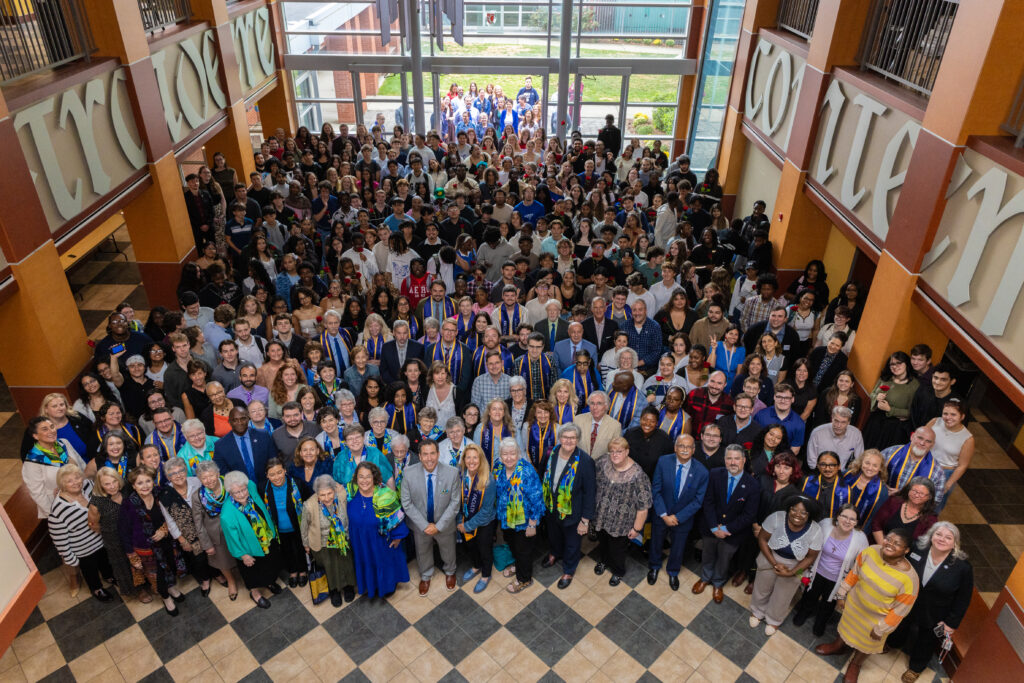

Albertus Magnus College Marks Its Centennial:
100 Years of Study, Prayer, Community and Service
When Albertus Magnus College opened its doors on September 24, 1925, Elenor Goode Sanders stood among the inaugural class on New Haven’s Prospect Street. She couldn’t have known then that her decision to attend New England’s first Catholic residential liberal arts college for women would spark a century-long family legacy. Nor would she have known that, 100 years later, her granddaughter, Carolyn Behan ‘86, would help bring Albertus into its next century. Today, that granddaughter co-chairs the Albertus Magnus College Centennial Committee, which has been planning the anniversary celebrations.
“My grandmother was there on opening day,” recalls Behan, executive director of college events. “She graduated in 1929, became a teacher and helped set a path that so many of us would follow.”
Investing in the next century of transforming lives
The Forever Albertus Centennial Campaign’s goal to raise $40 million is the most ambitious fundraising initiative in the college’s history. The campaign began quietly in 2023. When efforts surpassed $25 million, Albertus Magnus marked the momentous occasion by throwing a celebratory event in September for alumni, supporters and community leaders.
Albertus President Marc M. Camille, Ed.D., notes the campaign’s significance in the college’s efforts to continually invest in the Dominican Sisters of Peace’s four pillars: study, prayer, community and service. “This campaign is not just for a new building,” he says. “We’re raising money for scholarship funds; endowment funds; programmatic support to invest in our faculty, staff and students; and capital projects.”

Camille emphasizes that the campaign’s priorities are rooted in giving students access to experiential learning opportunities that connect academic study with today’s workforce realities. Funds from the campaign will expand these opportunities by raising monetary support for study abroad, community-based projects and paid internships. For instance, the college plans to build on the success of its federally funded SAGE Scholars, a summer research program, which provides science students—many from underrepresented backgrounds—six weeks of immersive, faculty-guided research.
“Many of our students can’t afford to take time away from work or family responsibilities,” says Camille. “Philanthropy allows us to open those doors.”
Emerging technologies are part of that vision, including a virtual reality learning experience. “For students who can’t afford to travel abroad, this kind of virtual immersion can recreate that sense of discovery and connection,” Camille shares. “It will be a game changer for our students.”
The college’s rapidly growing nursing program, launched less than three years ago, also benefits from donor support.
One family’s multigenerational bond with Albertus Magnus
These successes represent Albertus Magnus’ commitment to transform lives, which began when the Dominican Sisters of Peace established the college. At the time, only men had access to education, and so the congregation created Albertus Magnus for women’s education.
Behan is aware of how much her family’s legacy embodies Albertus Magnus’ community impact. After her grandmother Elenor was part of the first graduating class in 1929, Elenor’s sister, Mary Goode Rogan, graduated in 1936 and went on to Yale Law School; she was just one of four women to earn a law degree in 1938. Eventually, Mary served as a superior court judge until her retirement in 1990.
Behan’s mother graduated from Albertus in 1955 as the first daughter of an alumna to do so, followed by Behan and her three nieces. “We’ve had a family member tied to Albertus in nearly every decade,” Behan says. “It’s part of who we are.”
A weekend of memories and meaning
Her family’s ties to the college were evident during the Centennial Celebration’s opening weekend when Albertus Magnus announced it had raised $25 million towards its $40 million goal. Inside the Campus Center, easels displayed personal moments including photos of Behan’s own family.
“There was a photo of my mom from the 1950s serving tea,” Behan recalls. “She has dementia now, but she came to Founders Day and recognized herself right away. She could name everyone in the photo.”
To experience these celebrations, guests first had to enter through what Behan calls an “experience tunnel,” a walk-through timeline lined with oversized photographs from the 1920s through the 2020s that attendees connected with and reminisced about.

A Centennial to Remember
One creative component was the Centennial Silks project, a multigenerational collaboration with an Albertus graduate and graphic design major named Erin Molkenthin ’24. The final design was inspired by the stained-glass windows of the Saint Catherine of Siena Chapel, created decades earlier by Behan’s former art professor, Sr. Thoma Swanson O.P. “The silks incorporated colors representing our four Dominican pillars,” she says. “It became a symbolic piece of our identity.”
The Centennial also included a meaningful sustainability project that reflects Albertus’ commitment to social good. An American company that employs disadvantaged individuals in a supportive work environment converted old Albertus billboards into centennial tote bags.
The college plans to recreate these events when the Centennial closes in September 2026. “The opening was about reflection and pride,” Behan says. “The closing will be about looking forward.” The Centennial reflects something enduring. “The fact that we are thriving—evolving yet still guided by the same Dominican principles—is extraordinary.”

Learn more at admissions.albertus.edu/portal/forever-albertus.
More Stories
In Every Generation, She Rose: How Albertus Women Have Shaped a Century of Change
Goodbye Summer, Hello School
Exploring the Shift in Parental Support During Adolescence