

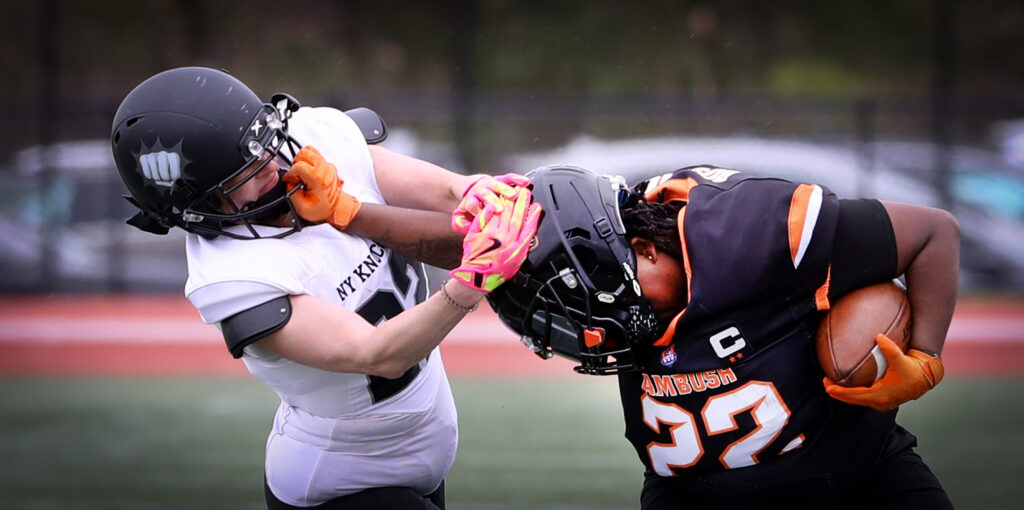

League of Their Own: Connecticut Women Tackle Football
By Stan Godlewski
Jessica LaSane was the only girl who played touch-football in the street with the boys in her Danbury neighborhood. Back then, the goal lines were, “from this telephone pole to the back of that Buick.”
Today, at 37, she’s been playing women’s football for 14 years. Though she grew up loving two-hand touch, she says there’s something about playing tackle ball that’s just more satisfying.
“It’s the hitting,” LaSane states matter-of-factly. “A lot of the players seem like the nicest people,” she continues, looking out at the field at Veterans Memorial Stadium in New Britain before the Connecticut Ambush took the field against the New York Knockout. “But when I put my pads on, it’s a different story.”
“I like blocking better. I like to protect my quarterback,” says LaSane, who plays offense and defense like most team members, but she likes defense best. Protecting and supporting each other is a big part of what this Connecticut Ambush team is all about. And while it isn’t unusual for a defensive player to flatten a running back on the other team, you might also see them help the player up, while asking if they are ok.

To a person, the Connecticut Ambush players enjoy the physicality, the running and the hitting of football. But they love the camaraderie.
Offensive guard and defensive end Karleigh Webb, 55, sums it up: “This is family. It’s all about your mates. [On the field] you are one of 11… and you don’t want to let your 10 sisters down. Out there…it’s about them, it’s about us.” Webb was raised in Nebraska where, “football is like oxygen.”
Not Just a Men-Only Sport
Women’s football may be new to some, but women have been playing the game practically since it was invented, according to an 1892 article in The Daily Times of New Brunswick, N.J. It reported that students at the Philadelphia School of Design for Women played, although with modified tackling rules.
A decade later, there were articles about students in at least two women’s colleges — Wellesley in Massachusetts and Vassar in New York — playing football for fun. By the 1930s, there were a few short-lived women’s football leagues. In 1965, talent agent Sid Friedman founded the Women’s Professional Football League (WPFL) as more of a barnstorming entertainment idea. Friedman imagined the women playing in mini-skirts and tear-away jerseys for exhibition, charity and NFL halftime events.
By the early 1970s, the athletes had had enough of Friedman’s form of football. Many players and team owners left to establish the first legitimate, competitive professional women’s league, National Women’s Football League (NWFL), in 1974. It didn’t last, but it was followed by others.
Founded in 2000, the Independent Women’s Football League (IWFL) was the first women’s American football league created by women. It endured for nearly two decades with popular teams in smaller markets including Kansas City, Sacramento, El Paso and San Antonio, to name a few. At about the same time, there was the United States Women’s Football League (USWFL) which had its first game in 2010 and lasted until about 2018. Today, the leagues include the Women’s Football Alliance, which describes itself on its website as, “the largest, longest running and most competitive women’s tackle football league in the world.”
And the American Women’s Football League (AWFL), which includes the Connecticut Ambush among its nearly three dozen teams, states on its website that, “this is more than a league. It’s a movement.”
Women’s Football Here to Stay
Despite having jobs and families, the Connecticut Ambush players commit to each other for the season, which is six games, two practices a week and one night a week reviewing film from the latest game. Recruiting for the team begins in late summer.
The Ambush is one of 34 teams in the AWFL, founded three years ago with six teams and growing fast. This year, the conference champions will vie for the league championship at the Emerald Bowl in the summer in San Antonio.
Quarterbacking the Ambush is Sam Valentino, who, when she’s not making a handoff or looking for a receiver, is a math teacher at Danbury High School. She’s also the team’s kicker.
After playing soccer, basketball and softball in high school, she played soccer and basketball in college. For the past nine years, she’s been playing women’s football. “You always think that when you’re a kid, the sports are gonna end, at some point,” Valentino says, taking a break from warm-ups this spring. “And it’s amazing that you get to continue to do this.”
As quarterback, she knows all the plays, and there are a lot of them. “We’ve got run plays, we’ve got pass plays, we’ve got play action,” Valentino explains, noting that the playbook is complicated and deep. During the game, she stays in touch with the sideline and gets the plays called through their offensive coordinator via headsets.
Valentino gets and calls the plays in the huddle, but Coleen Vacirca makes the calls off the field. Vacirca decided to tackle the job of owner and president of the Ambush team about three years ago after moving to Connecticut from Long Island. At the time, her daughter, Zoe Pilz, was playing for one of the three women’s teams in Connecticut. For various reasons, those three teams were merging into one. Vacirca saw the opportunity to get more involved and keep her daughter on the field.
Pilz, 22, played football starting in the fourth grade on Long Island, the only girl on the boy’s youth teams, and then in middle school, she says proudly.
“She was the one that has loved football her whole life,” explains Vacirca about why they committed to keeping a team active in Connecticut. Her job isn’t about running, throwing or tackling. It’s primarily about keeping the team in the game by finding funding.

“We’re a nonprofit,” Vacirca says, noting that there are more expenses than are covered by the pay-to-play fees paid by each player. “It’s hard to find the money.”
The AWFL has requirements. “We can’t just go play on some random field somewhere,” Vacirca explains. They need to have facilities and locker rooms.
This season, they played their home games at Veterans Memorial Stadium in New Britain, an impressive, but costly, venue. Then there are the away games; their last away game of the season was in Rochester, N.Y., against the Upstate Lady Predators, a round trip of about 700 miles.
“We wanted to rent a bus,” says Vacirca. With the bus costing close to $6,000, everyone drove themselves. “And then we pay for hotels and we pay for our meals…we pay for everything. So, yeah, the fundraising piece of it is hard.”
It’s more difficult getting sponsors in a smaller market like Connecticut, Vacirca says. Teams in Boston or Houston (which has two teams, the Power and the Doom) have more resources.
On the flip side, in Connecticut, the Ambush get involved in the community. “We do a lot of pride fests and we do some community volunteer work. We try to help and be active and…do things that get our name out there,” Vacirca continues.
The strategy appears to be working as the team’s fanbase is growing with people other than friends and family showing up in the stands and online followers now in the thousands.
Whatever it costs in money, time, pain and dedication, for the women, it’s worth it. “This is the best team I’ve been a part of in my life,” states Webb. “This takes me back to being a kid again. Because, hey, it’s not about egos, it’s all about us. It’s all about your friends. These are my 30 big sisters out here.”
Thirty sisters make for a big family that needs some strong parenting. That’s part of the job of head coach Lorie Lindo leading the Ambush when she’s not fulfilling her role as a sergeant with Connecticut State Police.
“I started playing football in 2011 with the New England Nightmare football team and fell in love with the game ever since,” Lindo says.
After the 2020 season (cancelled due to COVID-19), Lindo moved into coaching, first with the Western Connecticut Hawks, and then with the Ambush since 2024. “Leadership has no gender. Being able to share my knowledge with these ladies, watch them grow over the years and help pave the path for the next generation is very rewarding.”
She enjoys, “the opportunity to coach females in a predominant male sport and the opportunity to break barriers and be a trendsetter for the younger female generations that are getting involved in football.”
Lindo notes how women are involved in every level of the game now, from Jen Welter coaching with the NFL’s Arizona Cardinals in 2015 to Sarah Thomas officiating the Super Bowl in 2021. “It has taken females many years to break stereotype barriers and we are just beginning,” she adds. “The opportunities for us are endless!”
But for all the camaraderie, the enthusiasm and the devotion, there’s a consistent goal for the team. “Vince Lombardi said it best,” Webb concludes. “Winning isn’t everything. It’s the only thing.”
Regardless of the score at the end of a game, every member of this team walks off a winner.
With their 75-0 win over the New England Rebellion on May 30, the Ambush secured a trip to the playoffs in San Antonio, Texas. They compete in the Wild Card Round on June 13 in Rochester against the Upstate Lady Predators.
If they win that then they move on to the playoffs and potentially the championship game, which is called the Emerald Bowl. It will take place in San Antonio, Texas on July 25.
Find out more news, schedules, team store and joining information about the Connecticut Ambush team at ctambushfootball.com.
Stan Godlewski is an editorial, corporate and healthcare photographer based in Connecticut and working primarily between Boston and New York City.
More Stories
The Lessons of a Summer Job That Last a Lifetime
Scuba Divers Are Sinking to New Lows for Golf Balls
The Connecticut Summer State of Mind