

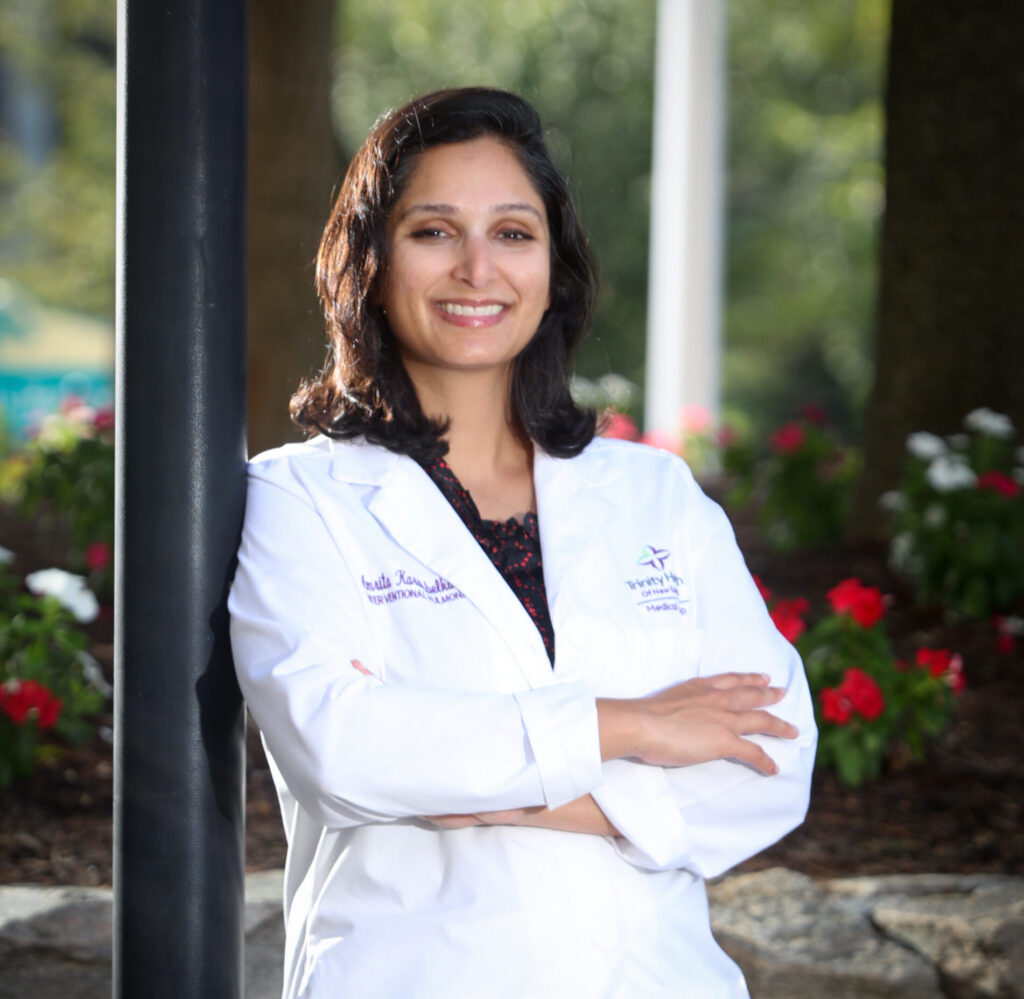

Amrita Karambelkar, M.D.: Bringing the Future of Lung Care to Connecticut
By Kimberly Lucey Millen
When a patient suffers from a severely narrowed airway, even the simple act of breathing can become a daily struggle. For years, physicians relied on airway stents manufactured in standard shapes and sizes to help keep those airways open. While effective, they weren’t always a perfect fit for everyone. Now, that is beginning to change. At Saint Francis Hospital, Amrita Karambelkar, M.D., assistant director of interventional pulmonology, is helping to bring a new generation of personalized treatment to Connecticut.
Using advanced imaging and 3-D printing, physicians can now create patient-specific airway stents designed to match an individual’s unique anatomy. It’s an innovation that has the potential to improve comfort, reduce complications and enhance long-term outcomes. “Patients’ airways are much more complex structures than a simple tube,” Dr. Karambelkar explains. “By designing a stent specifically for the patient’s airway, we can minimize complications and provide a much better fit.”
For Dr. Karambelkar, the procedure represents more than a technological milestone. It’s another way she’s helping patients breathe easier while bringing some of the most advanced pulmonary care available closer to home. The highly specialized stent procedure requires extensive training to place, adjust and remove the customized devices safely. In 2025, Dr. Karambelkar performed Connecticut’s first patient-specific airway stent placement, marking an important milestone not only for Saint Francis Hospital, but for patients throughout the region. “It really feels like the future,” she says. “I can bring an idea to our team and say, ‘I think this patient needs a custom stent,’ and have the full support to make it happen quickly. It’s a testament that we’re truly on the cutting edge at Trinity Health Of New England.”
A Passion for Pulmonary Medicine
Although she grew up in eastern Massachusetts, Dr. Karambelkar’s medical training took her up and down the East Coast. She attended medical school in New York City before completing her residency in Atlanta, where she discovered that pulmonary and critical care medicine offered exactly the kind of career she was looking for. “The lungs are such a vital organ, and pulmonary medicine really interfaces with every other discipline,” she says. “People often need prompt care, and I liked being able to care for patients both in the hospital and in an outpatient setting.”

During fellowship, mentors introduced her to advanced bronchoscopy, where minimally invasive procedures can diagnose and treat complex lung diseases. “I had wonderful mentors and physician colleagues I could learn from,” states Dr. Karambelkar. “I really enjoyed doing procedures and then taking care of patients afterward.” That interest eventually led her to complete the prestigious Harvard Combined Interventional Pulmonology Fellowship before joining Saint Francis Hospital.
Training During an Unprecedented Time
Part of Dr. Karambelkar’s fellowship and early career unfolded during the COVID-19 pandemic, when respiratory specialists found themselves on the front lines. “It was a difficult time to be training as a critical care physician,” she explains. “But it also showed the impact we can have. We touched a lot of lives and improved many more during that time.” The experience served to deepen her understanding of severe respiratory illness while reinforcing an important lesson. “I think overall it humbled all of us as providers in terms of how much we don’t know about the effects viral respiratory illnesses can have on people’s lungs.” Even today, she says, research continues to shape physicians’ understanding of long-term lung disease and recovery following the pandemic.
Choosing Saint Francis
For many physicians with advanced fellowship training, large academic medical centers are the expected destination. Dr. Karambelkar saw something different at Saint Francis. “What led me here was the hospital’s commitment to a community-based program, but with a lot of advanced technologies and resources,” she says. “It allowed me to practice all the parts of pulmonology I trained for while continuing to teach residents, participate in research and help grow new programs.” That combination of academic-level technology within a community hospital made Saint Francis the ideal place to build the kind of practice Dr. Karambelkar envisioned. She also found a collaborative culture that matched her own approach to patient care. “I was really impressed with how well the team works together,” continues Dr. Karambelkar, who works alongside thoracic surgeons, medical oncologists, radiation oncologists, pulmonologists, radiologists, nurses and other specialists as part of the Thoracic Oncology Program. It provides coordinated care for a patient from diagnosis through treatment.
Detecting Cancer Before Symptoms Begin
While advanced procedures often capture attention, Dr. Karambelkar believes one of the biggest opportunities to save lives begins long before patients ever need an operation. “The ultimate goal is to detect lung cancer before any symptoms appear,” she says. “Unfortunately, symptoms often happen very late, when treatment options become much more limited.”
The Lung Cancer Screening Program at Saint Francis offers annual low-dose CT scans for eligible patients with a history of smoking, allowing physicians to identify suspicious lung nodules when they are still small and highly treatable. Since its launch, the program has completed more than 2,000 lung cancer screenings and continues to grow. More than half of the lung cancers it has detected were diagnosed at Stage I, compared with approximately 16 percent nationally, giving many patients access to treatment when their disease is still highly curable. “There is still a lot of education and awareness that needs to happen,” Dr. Karambelkar says. “We want people to understand that screening is preventive care. The earlier we find something, the more options we have.”
Ensuring No One Falls Through the Cracks
Not every lung nodule is discovered during a scheduled screening exam. Many are found unexpectedly during imaging performed for another reason. As director of Saint Francis Hospital’s Lung Nodule Program, Dr. Karambelkar oversees a coordinated process that reviews these incidental findings and helps ensure patients receive the follow-up they need. “It helps make sure that no patient falls through the cracks,” she states. By combining advanced technology with multidisciplinary review, the program supports primary care physicians while making sure potentially concerning findings receive the attention they need. “Primary care physicians have an enormous amount of responsibility and shouldn’t be the only line of defense,” says Dr. Karambelkar. “Across the country, we’re moving toward formalized programs with dedicated personnel so these patients are identified and followed appropriately.”
Looking Toward What’s Next
Dr. Karambelkar believes interventional pulmonology is entering one of its most exciting eras. Advances in robotic bronchoscopy continue to improve physicians’ ability to diagnose lung disease earlier, while emerging therapies may eventually allow some early-stage tumors to be treated without surgery. “We’ve made tremendous strides in changing outcomes for lung cancer,” she says. “People often think about someone they knew years ago who had a poor prognosis. Today, because of those enhanced screenings, if we catch lung cancer at Stage I, the success rates are dramatically different.”
For Dr. Karambelkar, the most meaningful advancement isn’t simply developing new technology, it’s ensuring patients throughout Connecticut have access to it. “I think it’s very important to convey that when patients have disease or illness, they’re not geographically limited,” she concludes. “They don’t need to go to Boston or New York for that care. We want people to know they can receive the best personalized, most technologically advanced treatment right here in their own community.”
Kimberly Lucey Millen is a freelance journalist with more than two decades of experience in both print and broadcast media. She lives in New England with her husband and son, exploring all that each of the four seasons has to offer.
Stan Godlewski is an editorial, corporate and healthcare photographer based in Connecticut and working primarily between Boston and New York City.
More Stories
CORNELL SCOTT-HILL HEALTH CENTER: Child & Family Guidance Expanding Impact for Youth and Families
Summer Well-Being Starts Outside
Full Circle: How Dr. Jeffrey Brown Turned a Summer Mentorship into a Career of Service